

Longevity 5 min read Sep 30, 2026
Your vitamins were never designed to go through your skin.
The science of transdermal delivery, and why most wellness patches are not doing what they claim.
 Lauren HawkinsFounder & CEO · BSB, BSN, RN, CCRN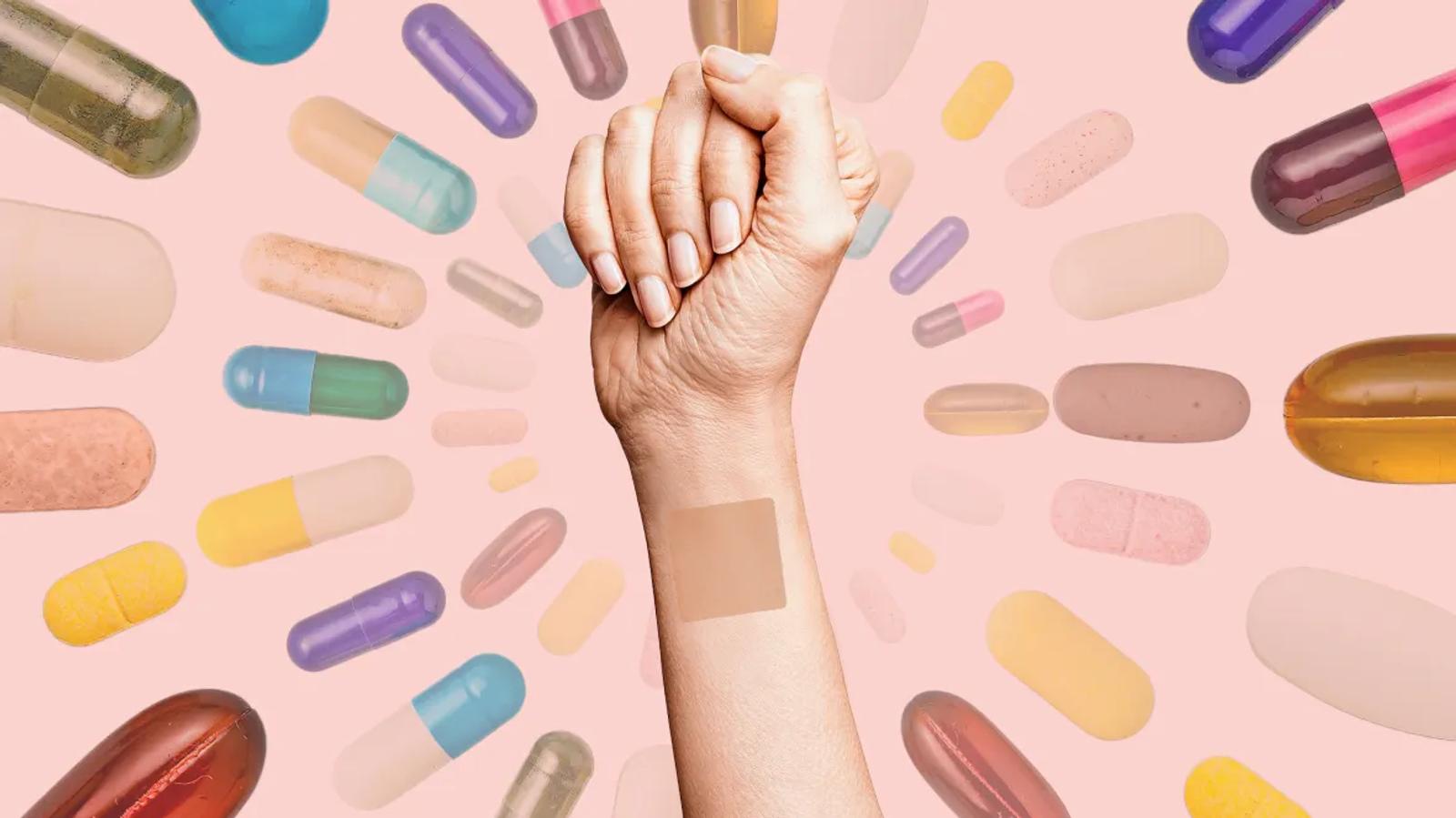
The wellness patch category is having a moment. Glutathione patches, magnesium patches for "brain fog," melatonin patches, energy patches, slimming patches, and vitamin D patches are now stacked on shelves and flooding your algorithm, each promising to deliver a nutrient through your skin instead of down your throat.
We are not wearing them. Here is why.
Your body is not built to absorb vitamins through your skin
Vitamins are meant to be absorbed through your GI tract or delivered into your bloodstream. That is how we evolved. Your gut has a specialized architecture, transporters, and pH gradients designed to break down and pull nutrients into circulation. The outermost layer of your skin evolved for the opposite job. To keep things out: water, bacteria, toxins, including vitamins you rub on your arm. All of it. It is genuinely good at the job it does, or we would not be standing here today.
Only very small, very lipophilic molecules can passively cross that barrier in meaningful amounts. That is why the pharmaceutical world has spent forty years developing the small handful of transdermal drugs that actually work. Estradiol patches, nicotine patches, fentanyl patches, scopolamine patches. Each one is the product of decades of engineering to deliver a molecule that fits a very narrow set of physical characteristics through skin that was not designed to let it through.
Vitamins are a different problem. Most of them are the wrong size or the wrong solubility to just slip through your skin the way estradiol can.
Vitamin D has the strongest case, and the strongest case is not great
Vitamin D is small, fat-soluble, and closer to what could theoretically cross the skin barrier than most other vitamins. There is active pharmaceutical research on transdermal vitamin D, including an ongoing clinical trial on a modified vitamin D phosphate. There is something here, but it is happening in engineered forms in clinical trials, not in the patches you are buying online.
And even if it did work, D3 taken orally with a meal that contains fat is one of the most reliable, well-studied, cheap, and easy supplements on the planet. Yes, it takes consistency and time to bring your levels up. That is how vitamin D works. Consistency is the whole point of any supplement protocol.
The logistics do not work
Even if consumer patches did eventually catch up to the science, there is a practical problem no one seems to talk about. How many patches are you actually going to wear? One for glutathione, one for vitamin D, one for magnesium, one for B12, one for melatonin at bedtime, one for iron, one for the microneedle "brain fog" patch on your temple during a work call. You are now covered in stickers.
Absorption from a patch also depends on where you put it, how long you wear it, and whether the delivery technology is engineered well enough to actually push the ingredient across the skin barrier at the dose the label is claiming. Consumer patches, in most cases, do not have that engineering. Skip a step, take a shower, sweat during a workout, put the patch in the wrong spot, forget the timing, and the absorption drops further.
Compare that to a supplement taken with breakfast. Fifteen seconds. Reliable. It works.
The one class of patches that has actually earned it
If you want to talk about transdermal medicine with real, decades-long clinical evidence, it is not in the wellness aisle. It is the estradiol patch. Modern hormone replacement therapy delivered through the skin has forty years of research behind it, an established pharmacokinetic profile, and, as we wrote about recently, has now been formally recognized by the FDA as one of the most powerful preventive protocols we have for women.
That is what real transdermal medicine looks like. Engineered molecule, engineered delivery system, decades of trial data, clinical outcomes. It is not what most of the wellness aisle is selling.
Where we land
Your vitamins were never designed to go through your skin. Your GI tract and your bloodstream have been doing this job for a very long time. If you want your D3 to work, take it with fat. If you want your magnesium to work, take it orally before bed. If you want your glutathione to work, take it in a form that has real absorption data, or deliver it through routes that are already established.
The physiology is not new. It just has not been as easy to market.
Editorial disclosure
Editorial content is general information, not medical advice, and is not intended to diagnose, treat, cure, or prevent any disease. Prescription treatments are available only where a licensed clinician determines they are appropriate. Eligibility varies by state.